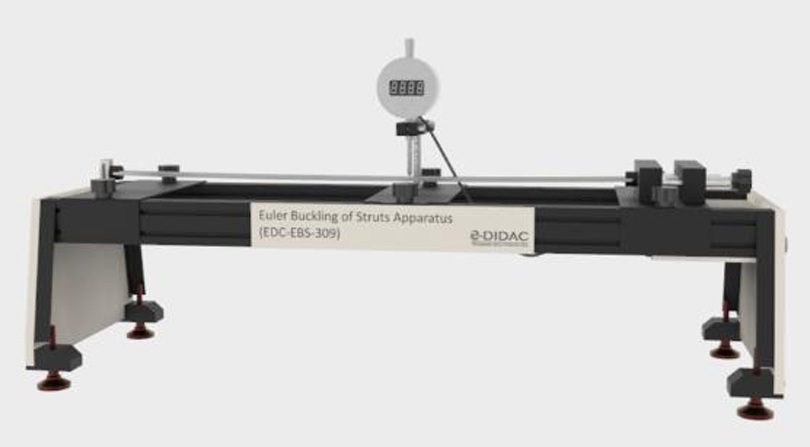
The apparatus is designed to study the buckling on different structs. In engineering mechanics, loss of
stability under compressive load is known as buckling. Under the effects of compressive forces, and under
increasing load, the axis of the bar deflects laterally until it suddenly and violently fails (collapses), even
before the fracture point is reached. The stresses in the bar often remain within the elastic range during this
process. This apparatus demonstrates the buckling behavior of bars under various influences.
For the purpose, one end of a bar is fixed or pinned, depending on the buckling case. A height-adjustable
load-carrying cross-arm and a hand-operated spindle are used to apply compressive force to the bar. A
bourdon type gauge measures the applied force. The lateral deflection of the bar is indicated on a dial gauge.
Experiments demonstrate various influences, such as bar lengths, materials and methods of support. A
transverse load application device can be used to generate additional shear forces on the test bar.
Specification
Data Not Found .......
Technical data
Data Not Found .......
Dimensions and weight
LxWxH:
Weight: